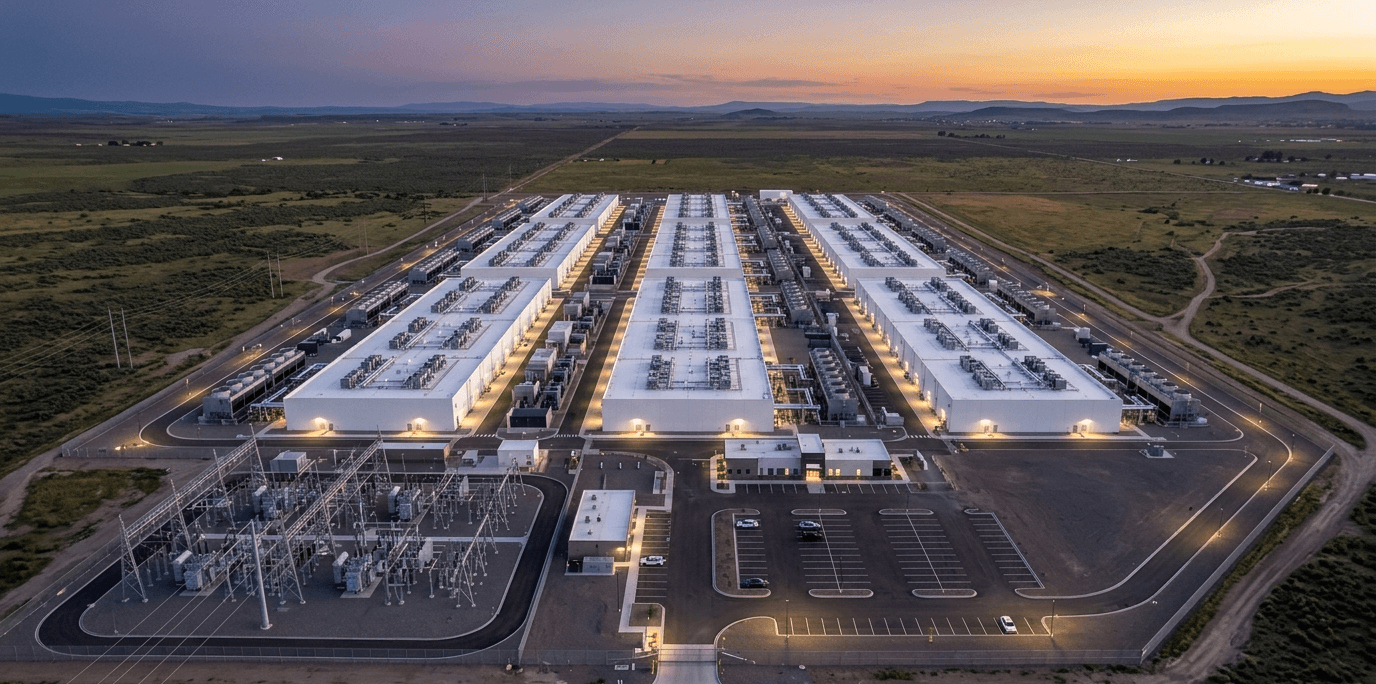
Data Center Facts
As of March 2026, there are 4,011 data centers in the United States — more than any other country by a wide margin, ahead of the UK (511), Germany (507), China (368), and France (344). Nearly 40% of all global data centers are located in the US.
The US accounts for approximately 54% of all hyperscale data center capacity worldwide.
The force driving the expansion of data centers is artificial intelligence. The shift from traditional cloud computing workloads to AI training and inference infrastructure has transformed data center economics, scale requirements, and energy consumption in ways that were essentially unforeseeable even three years ago.
The Top 4 US cloud service providers — Amazon, Google (Cloud), Meta, and Microsoft (Azure) — increased their combined data center capital expenditures by 76% in 2025 (Dell’Oro Group, March 2026), spending approximately $420 billion collectively.
Power is measured in watts (W), with larger units including kilowatts (1,000 watts), megawatts (1 million watts), gigawatts (1 billion watts), and terawatts (1 trillion watts). Watts indicate the rate of energy use or generation, while watt-hours measure total energy consumed over time. Most American homes use around 7,200kilowatt-hours (kWh) of electricity per year.
Data centers consumed 183 terawatt-hours (TWh) of electricity in 2024 — over 4% of total US national electricity consumption — and the International Energy Agency (IEA) projects that figure will grow by 133% to 426 TWh by 2030.
One gigawatt of power can supply roughly 750,000 average American homes.
183 terawatt hours could light approximately 178 million homes for one year.
The average data center size today is 80MW (megawatt) for facilities coming online in 2025— up from 25MW in 2020.
The top 7 wholesale data center markets are Northern Virginia, Dallas/Fort Worth, Silicon Valley, Chicago, Phoenix, New York Tri-State, and Atlanta.
US data center water use is estimated at approximately 1.7 billion liters per day.
The US data center sector has roughly doubled in capacity every three years — a pace that is placing extraordinary pressure on the national electricity grid, cooling water supplies, construction labor markets, and local zoning processes in the markets where development is most concentrated.
More than four out of every five megawatts colocation data centers underconstruction is already committed to a tenant before the building is finished; it is demand-driven construction where operators would build more if they could secure power and permits.
The US Interstate Highway System — the largest public infrastructure project in American history — cost approximately $530 billion in today’s dollars and took decades to build. The data center industry will spend twice that amount in a single calendar year, overwhelmingly driven by private capital from a handful of technology companies pursuing competitive advantage in artificial intelligence.
A typical data center = 100,000 households worth of electricity.
A hyperscale data center = 3.65 million average households / 5 standard nuclear reactors
Operational hyperscale data centers nearly tripled from ~450 (2018) to 1,297 (late 2025).
The power constraint is the defining challenge of the US data center industry in 2026, and its severity can be measured in a single statistic: Microsoft has disclosed an $80 billion backlog of Azure orders it cannot fulfill due to power constraints.
The average grid-connection wait time in primary data center markets now exceeds four years (JLL), meaning a project that breaks ground today in a constrained market will be waiting for a utility interconnection that won’t be available until 2029 or 2030. This mismatch is forcing hyperscalers to pursue solutions that were considered unusual just two years ago: directly contracting with power generators, building on-site generation (including natural gas peakers, diesel backup fleets, and increasingly, small modular nuclear reactors), and acquiring rights to existing generation assets.
Traditional data center workloads (enterprise software, web serving, storage, standard cloud computing) have predictable, moderate, and relatively stable power density requirements: a standard server rack might draw 5–10 kW.
An AI training cluster is a purpose-built computing instrument of a kind that has no historical precedent in commercial infrastructure. The 167% growth in liquid cooling projected between 2025 and 2030 is the engineering response to this density shift: air cooling that works for 10 kW racks cannot manage 100 kW racks, and the data center industry is in the middle of an unprecedented technology transition to liquid, immersion, and direct-to-chip cooling systems.
US states with multiple data centers generate $30+ billion in additional economic output annually.
The economic geography of US data center development is shifting in 2026 in ways that matter both for the industry and for US regional economic development. The Southeastern United States — led by Georgia, North Carolina, South Carolina, and Texas — is projected to become the largest US regional market by power capacity by 2030, accounting for approximately 35% of national data center capacity.
This shift is driven by three converging factors: power availability (the Southeast has more generation headroom than constrained Northern Virginia), land availability and lower development costs than coastal markets, and state governments actively competing for data center investment with aggressive incentive packages.
The 36 US states that now offer targeted incentives reflect a remarkable policy consensus that data center investment is worth competing for — it creates construction jobs, property tax revenue, and permanent technical employment, even as it strains electricity grids and water supplies.
The skilled labor shortage is the data center industry’s second most acute constraint after power availability. The scale of construction requires electricians, pipefitters, mechanical engineers, and construction workers in quantities that exceed the available workforce in many markets.
Source: https://theworlddata.com/data-center-statistics-in-us/#google_vignette